We use cookies on this website to provide a user experience that’s more tailored to you. By continuing to use the website, you are giving your consent to receive cookies on this site. Read more about our Cookie Policy and Privacy Policy.
Our professional teams can customize business solutions and deliver excellent customer service to support our customers’ business needs and continuous growth.
As an intelligent technology-driven digitalization enabler, we are committed to providing our customers with one-stop-shop ICT solutions with superior quality.
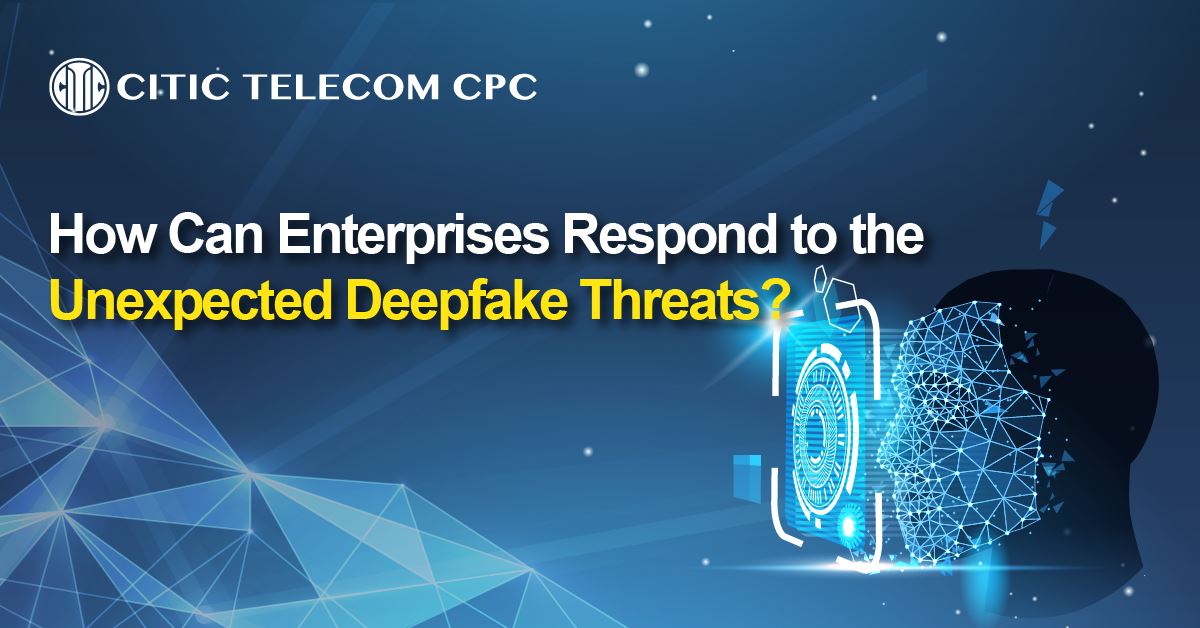
Recent local cyberattacks have highlighted the importance of cybersecurity in business operations, leading enterprises to adopt various cybersecurity solutions to defend against hackers. However, as traditional attacks evolve, cybercriminals have started to leverage AI technology such as deepfake to perpetrate fraud.
In February 2024, an employee in the finance department of a multinational corporation was deceived by cybercriminals using deepfake technology. They pretended to be senior executives of the "UK headquarters" in a video conference and instructed the employee to transfer nearly HKD 200 million. More recently, another cybercriminal also employed deepfake technology to impersonate a senior executive of a multinational company. The same thing happened again, the employee was deceived into transferring nearly HKD 4 million via the video conferencing. These incidents indicate the growing threats as deepfake becomes more sophisticated, suggesting an increase in potential victims. How should enterprises defend themselves? This article will explore deepfake and provide strategies to assist enterprises in safeguarding against such threats.
What is Deepfake?
By leveraging artificial intelligence, Deepfake combines "deep learning" and "fake” to create highly realistic fake images and audio that are hard to distinguish from genuine content. AI-based facial replacement is the most prevalent use of deepfake, where one person’s facial features are seamlessly swapped onto another's face, or someone's voice is mimicked to produce false audio recordings.
Deepfake utilizes deep learning to accurately replicate human facial expressions, vocal traits, and movements, coupled with extensive AI training data which greatly enhances the realism of the generated images and audio. With the rapid advancements in AI, deepfake tools and resources have become increasingly accessible. Open-source deepfake software and online platforms now allow ordinary users to easily create high-quality deepfake content, lowering the technical barriers for such fraudulent activities and making it increasingly challenging to detect fake content.
Cybercriminals are employing diverse and increasingly sophisticated deepfake fraud techniques, particularly in the area of social engineering. Here are some real cases:
By using deepfake technology, cybercriminals mimic the voices and faces of corporate management (such as CEOs or CFOs), and deceive employees of target companies by sending fraudulent videos, conducting video conferences, or making phone calls. They exploit employees' trust in company management to defraud employees into making emergency fund transfers or disclosing sensitive information, leading to financial losses or risk of data breaches.
Defamation
Cybercriminals create fake videos or audio to tarnish a company or its management's reputation. For example, they may produce fake videos of senior executives making inappropriate remarks and post them on social media, damaging the company's brand and potentially causing a drop in stock prices and the loss of customers.
Identity Theft
Deepfake-generated videos or audio have the ability to bypass enterprises’ security systems and identity verification processes, enabling cybercriminals to impersonate legitimate users to gain access to sensitive information or engage in other illegal activities.
Multi-Layer Defense Strategies to Minimize Deepfake-Related Losses
With the rapid development of deepfake, many enterprises and employees may be insufficiently aware of the associated risks, leaving them vulnerable to attacks. To address these emerging threats, enterprises need to adopt multi-layered defense strategies.
On a technical level, deepfake detection tools can be implemented to identify subtle differences in images and audio for distinguishing fake content. Additionally, multi-factor authentication (MFA) can also be deployed to enhance identity verification. To address business email compromise, reliable email security solutions should also be utilized to protect against email-based threats.
Raising employee security awareness is another crucial factor. Regular awareness training should be conducted to educate employees about the risks of deepfake and fraudulent content dentification tips. Moreover, simulating social engineering attacks can further prepare employees to respond effectively in real-world scenarios. A clear reporting mechanism and emergency response policy should also be established to ensure prompt reporting when employees face suspicious activities, enabling enterprises to respond quickly to minimize potential losses.
By integrating technical safeguards, comprehensive training programs, and well-defined policies, enterprises can effectively protect themselves against the threats posed by deepfake technology, ensuring the security and integrity of their business operations.
TrustCSI™ 3.0 – Tackling Future Threats with Intelligence
As your trusted TechOps Security Enabler, TrustCSI™ 3.0 utilizes AI to revolutionize the core capabilities of SOCs. Our TrustCSI™ Managed Security Service (MSS) leverages three of our self-deployed and self-managed SOCs and our team of security experts to provide 24x7 proactive monitoring, identify and analyze vulnerabilities, prioritize threats as well as refine security strategies and enterprise processes.
To enhance employee awareness against deepfake threats and other sophisticated cyberattacks, our team of security experts can assist enterprises in conducting “AI-Red/Blue Cybersecurity Practices” regularly to “stress test” scenarios and systems, as well as simulating different attack scenarios including phishing email drills and social engineering in order to elevate employee defense capabilities and identify the potential risks of enterprise for fast remediation. It can also facilitate asset identification, vulnerability assessment, and the identification of potential threats through AI penetration testing.
Our security experts can also assist enterprises in standardizing security strategies and provide a range of services from professional consultation, solutions design and implementation, transforming passive protection to proactive defense, significantly reducing the risk of data breaches.