媒体报导 @ FUTURECISO
从端点防护到供应链安全 (English Only)
As 2025 unfolds, CISOs in Southeast Asia and Hong Kong face an
increasingly complex and hostile cyber threat environment. The
technologies meant to accelerate transformation intensify risks, and
geopolitical tensions and regulatory changes have combined.
The Hong Kong Computer Emergency Response Team Coordination Centre
(HKCERT) reported a record surge in phishing attacks in 2024, with
phishing incidents rising by 108% year-on-year and malware cases
increasing nearly fivefold, signalling a significant escalation in
threat activity.
Southeast Asia similarly confronts rising cyberattacks targeting
critical sectors like finance, government, and technology hubs such as
Singapore. Ransomware and remote access trojans (RATs) are among the most prevalent attack vectors.
Endpoint security: The frontline defence
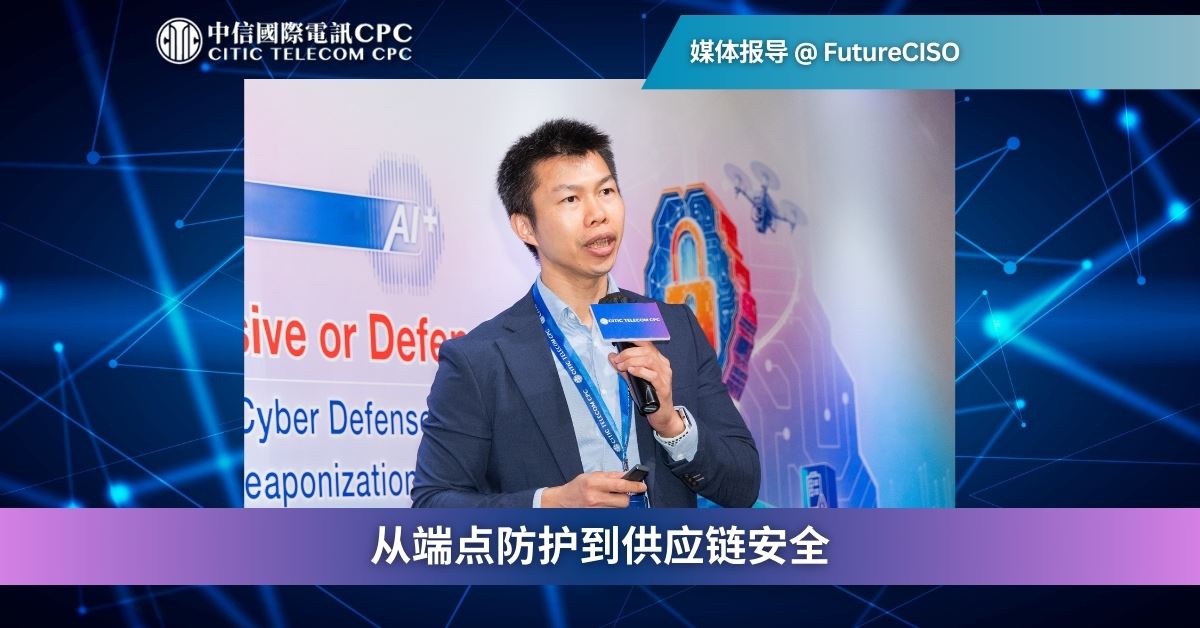
Dr. Sung Liu, a security specialist and senior product advisor at CITIC Telecom CPC, highlights endpoint security as a critical challenge for enterprises undergoing digital transformation.
He stresses that "endpoint defence is the first line of defence for
enterprises" and urges organisations to "start with endpoint protection
early to allow businesses to focus on their growth while mitigating
cyber risks."
He advocates controlling employee use of applications and shadow IT
tools to reduce data leakage risks. He also recommends sandboxing
suspicious files or links to prevent malware from spreading.
This focus on endpoint security aligns with broader industry priorities.
According to a LinkedIn analysis of CISO priorities for 2025,
endpoint protection and response remain a top concern, alongside
identity and access management, cloud security, and zero-trust
architecture.
The growing sophistication of attacks targeting endpoints demands
rapid detection and containment capabilities, a point Liu underscores by
citing cases where "quick incident response prevented ransomware from
spreading beyond initial devices."
Growing supply chain and third-party risks
HKCERT's 2025 outlook
identifies supply chain security as one of the primary cyber risks in
Hong Kong. This reflects a global trend in which attackers exploit
weaker third-party vendors to breach critical infrastructure and
enterprises.
Ir Alex Chan of HKPC, speaking on behalf of HKCERT,
warns that "hackers prefer the path of least resistance, shifting their
focus to breaching through third parties such as suppliers, contractors
or service providers."
This threat extends
to energy, transportation, banking, and healthcare sectors, with IoT
devices like digital signage emerging as vulnerable attack surfaces.
Liu echoes this concern by recommending that enterprises augment
their capabilities by engaging third-party managed security service
providers (MSSPs).
"CITIC Telecom CPC's TrustCSI Managed Security Services,
which combine AI-driven threat detection with deep industry expertise,
exemplify the kind of partnership CISOs should consider to address
complex supply chain and endpoint risks effectively." Sung Liu
Cybersecurity-as-a-service and managed security
The complexity and rapid evolution of cyber threats have accelerated the adoption of Cybersecurity-as-a-Service (CaaS) and managed security services in the region. Canalys
forecasts a 15% growth in managed services revenue in the Asia-Pacific
region in 2025, mainly driven by demand for security-first models that
integrate compliance, vertical expertise, and cloud-first
strategies. This trend reflects shifting from traditional IT support to
co-managed, security-centric partnerships.
Liu advocates leveraging such managed services to compensate for
internal skill shortages and technology gaps. He stresses the importance
of "integrated infrastructure, networks, operations, and cloud
application services to build a robust cybersecurity posture."
This approach aligns with the broader industry recognition that
cybersecurity requires specialised expertise and scalable, on-demand
solutions to keep pace with evolving threats.
AI and emerging tech: Double-edged swords
Artificial intelligence (AI) is a major theme in cybersecurity for 2025, both as a defence tool and as a vector for new threats.
HKCERT highlights AI content hijacking as an emerging risk, while
industry experts note that attackers increasingly use AI to automate and
sophisticate attacks.
Liu points to the integration of AI in managed security services as a
way to enhance threat detection and response capabilities and enable
faster incident containment.
However, the adoption of AI and IoT also expands the attack surface.
Southeast Asia's rapid digitalisation and growing cryptocurrency
adoption are attracting cybercriminals who target digital assets and blockchain platforms. CISOs must, therefore, balance innovation with rigorous security controls and continuous monitoring.
Regulatory and workforce challenges in Southeast Asia
Southeast Asia's cybersecurity landscape is shaped by a patchwork of
regulatory frameworks and a persistent shortage of skilled cybersecurity
professionals. Governments in Singapore, Malaysia, and Indonesia have
introduced stricter regulations
emphasising data protection and breach reporting, while regional
cooperation under ASEAN aims to combat transnational cybercrime.
Nonetheless, the gap between digital adoption and cybersecurity
awareness remains a critical vulnerability.
Positive Technologies' analysis underscores the need for improved
digital literacy and practical training to reduce the region's exposure
to cyber threats. It notes that "digital literacy across the population
is improving at varying rates but generally falls behind the pace of
digitalisation." CISOs must invest in employee training and awareness
programmes as a foundational defence layer, complementing technical
controls.
Practical recommendations for CISOs in 2025
Liu suggests CISOs in Southeast Asia and Hong Kong prioritise the following actions:
- Implement robust endpoint protection early, including application control, sandboxing, and rapid incident response capabilities to contain threats before they spread.
- Strengthen supply chain security by vetting
third-party vendors, conducting regular audits, and leveraging managed
security services with local expertise and compliance knowledge.
- Adopt Cybersecurity-as-a-Service models to access scalable, AI-enhanced threat detection and response, addressing skill shortages and regulatory complexities.
- Prepare for AI-driven threats by integrating
AI-powered security tools and continuously monitoring emerging risks
such as AI content hijacking and attacks on digital assets.
- Enhance workforce capabilities through ongoing training, awareness programmes, and collaboration with regional initiatives to improve digital literacy.
- In proactive incident response planning and regular penetration testing to ensure readiness against increasingly sophisticated attacks.
The cybersecurity environment in Southeast Asia and Hong Kong in 2025
demands a multi-layered, adaptive approach. Sung advises CISOs to
"balance innovation with vigilance, leveraging technology and
collaboration to safeguard their organisations against evolving cyber.